

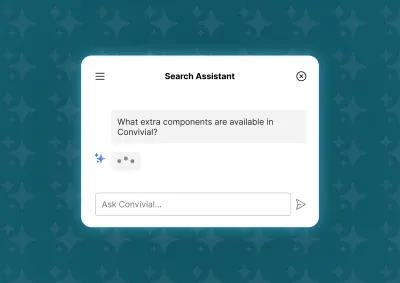
The Drupal AI module provides everything needed for a RAG chatbot. We cover the setup that government sites need to get right.
Frequently asked questions
Drupal supports enterprise search through Apache Solr, providing full-text search with faceting, content boosting, binary file indexing, date-based relevance scoring, and autocomplete. Morpht enhances this foundation with AI-powered search improvements including Sajari integration, regime-based result filtering (adjusting results based on user context), confusion matrix analysis to remove false positives, and search performance analytics. For complex government sites with large content volumes, well-configured search is often the single highest-impact improvement in user satisfaction.
Basic search handles simple keyword matching well, but large content repositories (thousands of publications, forms, fact sheets) typically need faceted search, relevance tuning, and synonym/typo handling to be genuinely usable; this is where dedicated search solutions (like Apache Solr integrations, common in enterprise Drupal builds) earn their cost over core search.
Search is often the safety net for weak IA. When users can't find something through navigation, they turn to search, so a site with strong faceted search can partially compensate for imperfect navigation structure, though the two should ideally be designed together rather than search being an afterthought.
Yes. AI-assisted search (semantic/natural-language search rather than pure keyword matching) is an active area of Drupal development, and can meaningfully improve findability for content-heavy sites where users don't always search using the exact terms content authors used. Though it needs to be implemented with the same accuracy and governance scrutiny as any other AI feature on a government site.
Insights

Article
In a previous post, we looked at how search can be improved through the use of a confusion matrix and the removal of false positives. This article takes the thought process a step further by looking at how context or “regimes” can be used to further improve results.

Article
Site owners and users naturally want the best, most relevant search results to be delivered to them. This article provides a framework for the evaluation of search results and offers suggestions on how results can be improved.
Article
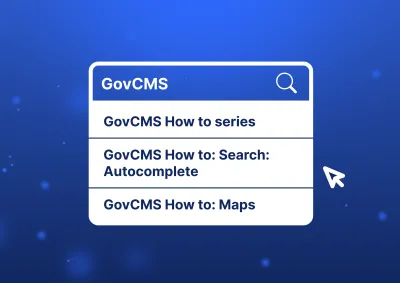
A guide to setting up search autocomplete on a GovCMS SaaS website.

Article
Search is a core competency of most websites, however, so often it doesn’t perform the way users desire. It’s possible to get good results from Search API in Drupal with a rigorous approach and a bit of fine tuning.

Article
As site owners and builders, we have all experienced projects with a tight deadline and challenges to deliver the project on time.

Case study
Morpht supported the Department of Health and Aged Care with a contemporary new website for World AIDS Day, in record time for World AIDS Day 2023. Providing a contemporary look and feel with improved content models and site search.

Case study
Morpht was able to provide IPEA with a new website on the GovCMS SaaS platform, upgraded to Drupal 9 and allow site editors to import all reporting data without the need of external help. The site also has a greatly improved page speed and a new design and interface which maximises the findability of Parliamentarian expense reports.

Case study
The TGA are now celebrating a brand new site on GovCMS. With a contemporary look and feel underpinned by consistent structures and familiar patterns, this site is now the foundation for the next stage of the digital transformation the TGA is undergoing.

Article
IPEA is a government authority tasked with the management and reporting of parliamentarian expenditure. In this case study we will show how the Migrate and Solr modules were used to solve scalability and performance challenges by providing a user and editor friendly solution.

Article
Google Analytics has recently introduced a new update. As a result of this update, Universal Analytics (the current system) will be retired on 1 July 2023.
Article
The Morpht team will be presenting at the upcoming DrupalSouth 2022 conference being held in Brisbane in October.

Article
Boost your Drupal SEO rankings by adopting a question and answer format for your content and utilising FAQPage markup.
Related content

Topic
The solid foundations provided by Drupal can be taken to the next level with personalisation and customization.

Service
SItemaps and content models support the needs of the user and help them discover the information they are looking for.

Service
We’ve delivered some of the most accessible sites for the most demanding of customers.

Service
Drupal is a powerful system under the hood and is capable of the most demanding content modelling needs.