

In a recent DrupalSouth blog series, Murray Woodman was interviewed for some hot takes on the new Drupal AI initiative and innovation in general.
Frequently asked questions
Morpht has integration experience across a wide range of third-party services. Key partnerships include Recombee (content recommendations), Sajari (AI-powered site search), and NLP Cloud (AI content augmentation). Morpht also integrates Drupal with CRM systems, government analytics tools (Google Tag Manager, Google Analytics 4), webform-to-CRM pipelines, mapping services (Leaflet, GeoJSON), and email/notification systems. For GovCMS SaaS sites, integrations must comply with the platform's constraints, but Morpht has deep experience delivering creative solutions within these boundaries.
Yes. Drupal's RESTful API architecture and extensive contributed module ecosystem make it straightforward to integrate with CRMs (Salesforce, Microsoft Dynamics), marketing automation platforms, data analytics systems, and content delivery networks. Morpht has experience implementing webform-to-CRM integrations, Google DataLayer configuration for marketing analytics, and progressively decoupled architectures where Drupal serves as the content backend for React-based front-end applications. These integrations make Drupal a central hub in a composable digital architecture rather than a siloed website platform.
Morpht works with a curated set of enterprise hosting providers. For GovCMS clients, hosting is on the GovCMS platform managed by the Department of Finance. For enterprise and state government clients, Morpht is a Pantheon Platinum Partner (Pantheon is a leading Drupal/WordPress hosting and WebOps provider) and works with Acquia (a leading Drupal cloud platform). This focused approach means Morpht's team has deep expertise in each platform's deployment, caching, and monitoring capabilities rather than spreading thin across many providers.
CRMs (Salesforce and others), identity providers/single sign-on, payment platforms (e.g. NSW's Customer Payment Platform), marketing automation, recommendation/personalisation engines, analytics and tag management, and data/BI visualisation tools. Drupal's API-first architecture (JSON:API, GraphQL) generally makes these integrations more straightforward than with simpler CMS platforms.
Yes. SaaS's shared, managed nature limits the custom code and direct system access available for bespoke integrations, while PaaS gives you the environment access needed for deeper, custom-built integrations. If a project's core requirement is a complex integration, that alone can be the deciding factor for SaaS vs PaaS.
Underestimating the "glue" work: authentication, error handling, data mapping between systems with different data models, and ongoing maintenance as the external system's API changes over time. A well-scoped integration project accounts for this ongoing maintenance cost, not just the initial connection.
Insights

Article
A review of where the web is at and where it is going. Buckle in. It's a little bit bleak but there are rays of light.

Article
Recombee is a “Recommender as a Service” which provides flexible and powerful ways to personalise recommendations for users.. This guide provides a step-by-step approach for integrating it into your Drupal website.
Article
This guide explores the benefits of integrating SendGrid with Drupal and demonstrates how to optimize email workflows with analytics and domain authentication.

Article
GovFlix is a website showcasing video content for government and web development. A “behind the scenes” presentation was recently given at DrupalSouth Community Day 2024.
Article
A guide to how GovCMS SaaS can be configured to handle the collection of data for safe transmission and storage.

Article
A guide to incorporating business intelligence visualisations into a GovCMS SaaS website.


Article
Augmentor AI is an ecosystem of flexible plugins that help authors uplift content in Drupal.

Article
Morpht is sponsoring and running a hands-on workshop demonstrating the various AI integration tools it has developed.
Article
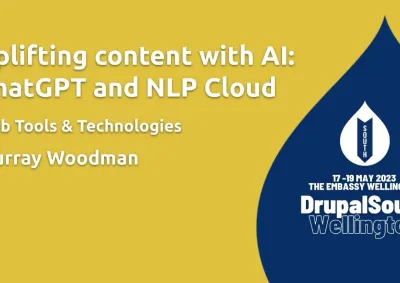
Murray Woodman, our co-founder, explores the integration of AI services, such as Chat GPT and NLP Cloud, into Drupal using modules like Augmenta and ECA. He showcases the configuration and use of these modules for content augmentation, summarization, and classification while discussing AI-generated content's potential benefits and challenges.
Article
Morpht's co-founder, Murray Woodman, answers questions about AI and Drupal.

Article
Quickchat makes websites smarter without a lot of extra effort.
Article
Morpht has supported the development of the Ayrshare module - an integration using a powerful API that effortlessly enables you to send social media posts.

Article
Morpht has developed the Quickchat Drupal module to allow for easy integration into Drupal, making it possible for editors to train the chatbot with content from within the CMS.

Article
Unlock geo personalisation features for your Drupal site by using Cloudflare workers to augment the request with geodata.
Article
Morpht developed an integration between Drupal, a CRM and the NSW Customer Payment Platform (CPP) for a NSW government agency.

Article
Both the Group and Scheduled Transitions are powerful modules in the Drupal ecosystem. Group Scheduled Transitions brings them together.

Article
VantaJS is a sweet little Javascript library which displays dynamic, interactive animated backgrounds. It is a natural fit for an implementation as a Modifier in Drupal.

Case study
A Drupal 8 build involving migration of content from a legacy CMS system and developing a technically challenging fail-safe data update functionality from a third party SOAP data feed.

Case study
The NSW Food Authority engaged Morpht to redevelop and refresh the design of its website and migrate the content from TRIM WCMS to GovCMS.

Article
One of the trickier aspects of any data migration is migrating users and ensuring that the authentication details which worked on the legacy site also continue to work on the new Drupal site. This article shows how it is done for .Net to Drupal 7.
Related content
Service
Experienced backend Drupal developers build custom solutions for your business logic and requirements.
Service
Using the Drupal CMS and related web technologies we have delivered successful projects across a range of industries and clients.

Service
Morpht’s AI integrations deliver smart automation, personalisation, and chatbots for Drupal, boosting engagement, efficiency, and content quality.
Service
Data is like wine. Enhance your data and improve your Drupal website with our integration services.