

Australian Children's Education and Care Quality Authority (ACECQA)

ACECQA publishes the National Register, the official record of about 16,000 approved children's education and care services. Morpht redesigned the website, migrated its content from a legacy CMS, and rebuilt how the register updates, so families and providers always see current information.

The outcome

ACECQA now has a faster, easier-to-search website and a National Register that updates reliably, processing only the records that change.

  • 99% average reduction in processing for National Register updates, across about 16,000 records
  • More than 19% faster average page load time
  • Page views up and bounce rate down after launch [Confirm: add the percentage change for each]
  • Every update checked through an admin dashboard showing fetched, updated, and deleted records

Overview

Drupal 11 | Migration | Web development | Search

ACECQA is an independent national authority that helps governments implement the National Quality Framework (NQF) for children's education and care. The register is one of its most used resources.

The project had two parts running at once: a content migration from a legacy CMS, and a fail-safe way to update the register from a third-party data feed without errors or gaps.
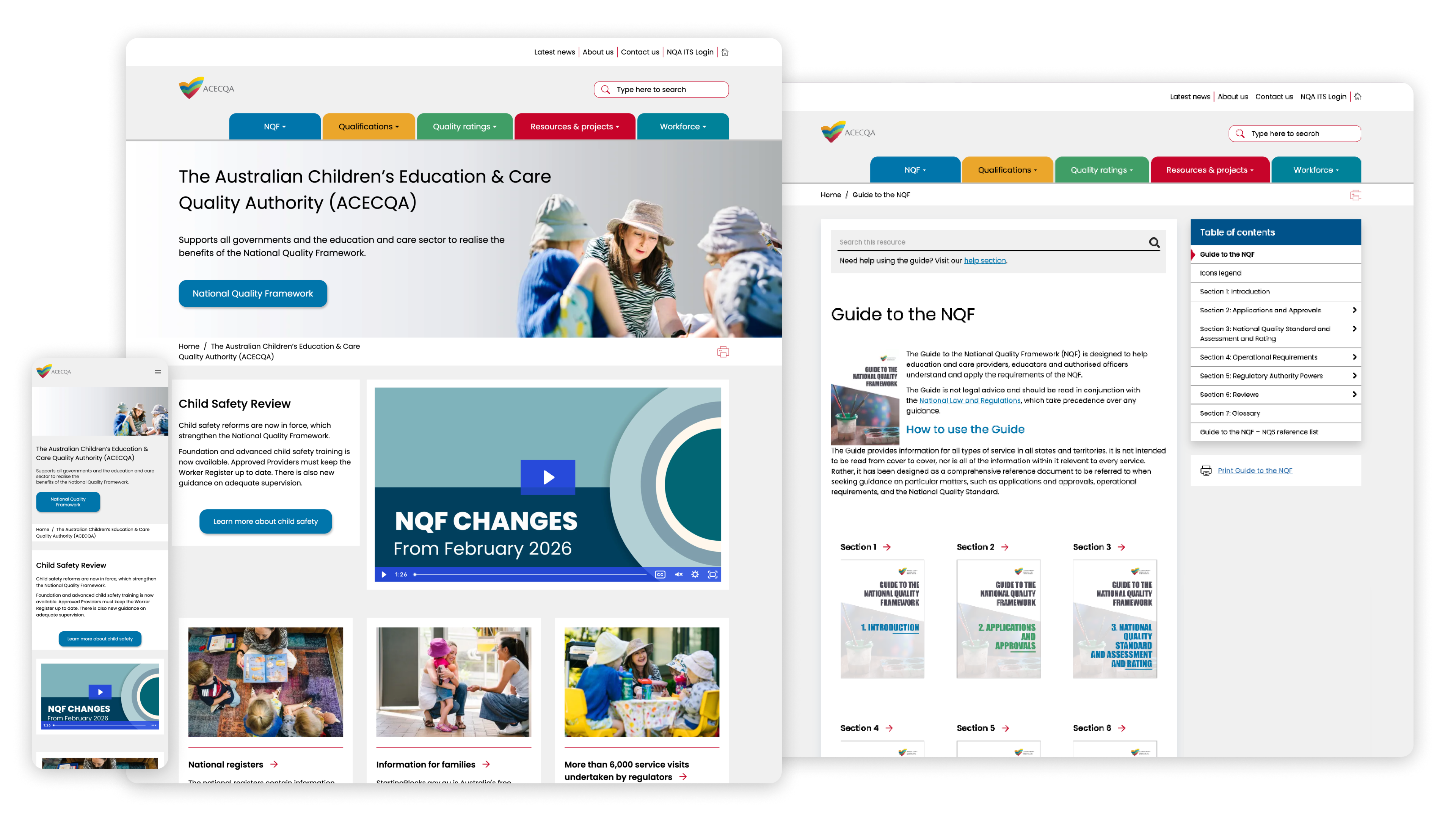
Visit the site

ACECQA website screenshots

The solution

After initial discovery, Morpht began specification and data modelling. Our design partner, Sydney-based Folk, led research, user experience, and design in parallel.

ACECQA - Website on tablet and mobile devices

New design

The design is content-first, with inviting imagery and a focus on ease of use and accessibility. Search was redesigned so users can reach service provider data quickly, even though the site is data-heavy.

ACECQA - website on mobile

Content migration

We downloaded and examined the legacy CMS database, then used extensive scripting to consolidate the content into a modern content model.

ACECQA content migration

National register data update

The initial data processing module utilising a SOAP endpoint was improved during development to include small data segment processing and triggers to repeat failed data update processing. A hash comparison method was utilised to limit the number of updates across approximately 16,000 records to reduce the load on the system. The result was an average 99% reduction in processing requirements.

An admin dashboard reports the number of fetched, updated, and deleted records. Administrators can also run an update at any time with a manual trigger.

ACECQA National Registers

Related case studies